Alimos
The
first settlements uncovered by archeologists in Alimos date back to
the Neolithic period and the
excavation site can be found in the region of Euonymia (Ano Kalamaki), immediately by the Vouliagmenis Avenue.
In
classical antiquity, Halimous
(Ancient Greek:
Ἁλιμοῦς;
also Alimous,Ἀλιμοῦς)
was a fishing town on the outskirts of the city-state of Athens and constituted one of the demes of Attica.
The area of Ano Kalamaki constituted a distinct settlement, which in
classical antiquity constituted the urban (Asty) Deme of Euonymon.
Testament to its development during this period are the ruins of the amphitheater of Euonymon, quite unusual in the ancient world in its rectangular
design. The site can be found on Archaiou Theatrou Street in Ano Kalamaki (just a few
blocks away from the Neolithic site).

The
most significant historical affiliation of Alimos is that with Thucydides.
Thucydides was born in Halimous, and is often referred to as
"Thucydides the Halimousian" (Greek: Θουκυδίδης
ο Αλιμούσιος).
The bust of Thucydides is the emblem of Alimos, which is commonly
used between schools in the area. Furthermore, the First High School
of Alimos is called Thoukydidio (Greek: Θουκυδίδειο),
after him.
Diros
Caves
The famous
Alepotripa and Vlichada caves
are located in Pirgos Diros. They were explored by the
speleologists Ioannis and Anna Petrochilos. The Alepotrypa cavern was
discovered in 1958. Archaeological research begun in 1970 under the
direction of archaeologist Georgios Papathanassopoulos. In the course
of the late Neolithic period (4000 - 3000 BC), the cave was
extensively used as shelter, dwelling, workshop, storage place for
goods, cemetery and a place of worship.

The richness and
quality of the unearthed findings witness the existence of a populous
society in Alepotripa,
which developed over time into an important centre that engaged
largely in trade, maritime travel, farming and stockbreeding.
Strangely enough, human skeletons were found on the surface, meaning
that entombment had not taken place.
This led archaeologist G.
Papathanassopoulos to the conclusion that these Neolithic people died
suddenly during a strong earthquake, which in turn generated huge
rockslides from the ceiling, thus blocking the cave's entrance. The
passageways of Alepotrypa, decorated with stalagmites and
stalactites, measure 500 m in length. The cave covers an area of
6,500 m2. The central cave ends in a very beautiful lake attaining a
maximum depth of 6 m. The cave is not open to the public, yet.


Mystras
 Mystras,
the 'Wonder of the Morea', was built as an amphitheatre around the
fortress erected in 1249 by William of Villehardouin. Reconquered by
the Byzantines, then occupied by the Turks and the Venetians, the
city was abandoned in 1832, leaving only the breathtaking medieval
ruins, standing in a beautiful landscape. The complex of the ruins of
Mystras offers the image of a city with a brilliant destiny that was
deserted by men and threatened by the return of encroaching
vegetation, which is splitting the walls and covering the slopes,
thus destroying here and there fragile traces of history.
Mystras,
the 'Wonder of the Morea', was built as an amphitheatre around the
fortress erected in 1249 by William of Villehardouin. Reconquered by
the Byzantines, then occupied by the Turks and the Venetians, the
city was abandoned in 1832, leaving only the breathtaking medieval
ruins, standing in a beautiful landscape. The complex of the ruins of
Mystras offers the image of a city with a brilliant destiny that was
deserted by men and threatened by the return of encroaching
vegetation, which is splitting the walls and covering the slopes,
thus destroying here and there fragile traces of history.
Mystras
came into existence in 1248-49 when the Frankish lord, William II of
Villehardouin, Prince of Achaia, resolved to build a great castle on
the top of the 620 m hill overlooking Sparta. The castle would
be able to withstand attacks by the Byzantines, and also contain the
Esclavons, the Slavic tribes of the Melinges and the Lezerites who
inhabited the Taygete. Although a few inhabitants continued to live
in the ruins, the city was not abandoned until after 1832, when King
Otto I founded the new city of Sparta. For almost six centuries,
Mystras lived a troubled existence. However, several times and under
different regimes it assumed a leading political and cultural role.
The vicissitudes of history did not spare the construction built by
William II of Villehardouin. The castle had barely been completed
when the Prince of Achaia, defeated by Michael VIII Palaeologus at
the battle of Pelagonia and made prisoner, was forced to cede as
ransom to the basileus the three strongholds of Monemvasia, Mania and
Mystras (1261-62). When the favour of victory momentarily shined upon
him once again, in 1265, Villehardouin found that the inhabitants of
Sparta had deserted that vulnerable city and taken refuge around the
castle of Mystras. From 1262 to 1348, because of many wars in which
it was often the prize, Mystras was the seat of the Byzantine
military governor, first named for a year then, after 1308, for life.
The bishopric of Sparta was transferred to the new city, and the
Metropolis, dedicated to St Demetrios, was built in 1264, and
reconstructed after 1310. Convents, such as those of the Theodore
Saints (prior to 196) and those of Brontochion (c.
1310) were built and richly decorated.

From
1348 to 1460 Mystras became the capital of the Despotate of Morea.
The despotate was the expression of the relative desire for
decentralization of the Cantacuzenes (1348-84) and the Paleologi
(1384-1460), who, according to a system modelled on feudalism,
conferred power to family, in most cases to sons or brothers. During
this period - the zenith of Mystras, when the Peribleptos and the
Pantanassa were built around 1350 and 1428 respectively - the
cosmopolitan city was a major piece on the political chessboard on
the Mediterranean. Most of the despots married Frankish princesses;
some made necessary alliances with the Turks, others with the
Venetians. In 1402 Theodore I Paleologus sold Mystras to the Knights
of Rhodes; only the hostile reaction of the population forced him to
cancel the transaction. After paying a tribute to Murad II at the
time of his victorious expedition in 1446, Mystras fell to Mohammed
II on 30 May 1460. The event was seen in the West and in the East as
being almost equal in importance to the fall of Constantinople in
1453.

The
beauty of the churches of Mystras, which during the Paleologus
Renaissance had been covered with dramatic frescoes, the renown of
the libraries of Mystras and the glory of its writers (including
Georges Gemiste Plethon and Jean Bessarion who brought neo-Platonic
humanism to Italy) gave substance thereafter for the legend of the
'Wonder of Morea.' Dominated by the Turks, conquered briefly by the
Venetians In 1669, then occupied for a longer period from 1687 to
1715, and recaptured in 1715 by the Ottoman Empire, Mystras never
recovered its past grandeur, although it still numbered some 40,000
inhabitants. The silk industry was the manufacturing and trading
city's only resource. Mystras was burned by the Albanians during the
Magna Revolt in 1770 and was in a state of decadence when it was
definitively abandoned.
Aegina
Aegina has a long history, dating from the Neolithic (4th millennium BC) to the later years. The high points in its history were the period if its great prosperity (657-459 BC) and the short period when it was proclaimed first capital and home of governor Ioannis Kapodistrias.
Witnesses to this historical path are the hill of Kolona with its characteristic column and the findings of ancient settlements, Paleachora with its post-byzantine churches, the Temple of Afea, the public buildings of the Kapodistrian period, Mount Hellanion/ Oros and the monastery of Chrysoleontissa. Some of the most important archaeological sights are below.


 On the site of the 5th century BC Doric temple of Afea in northeastern Aegina, an earlier temple existed from 570-510 BC which was destroyed by fire, though the cause is uncertain. One of the oldest of Greek Doric temples, its partial reconstruction is found in the inner portion of the Aphaia museum. This remarkable work was carried out by a man known locally by the Greek name Ludovikos, an "architectural archaeologist" who performed the most recent excavations on the site from 1967-84, in collaboration with German, English and Italian researchers. The workers were local Greeks, mostly from the nearby village of Mesagros, though also from Portes and Kylindros villages.

Paleachora ~ Aegina's Medieval Village
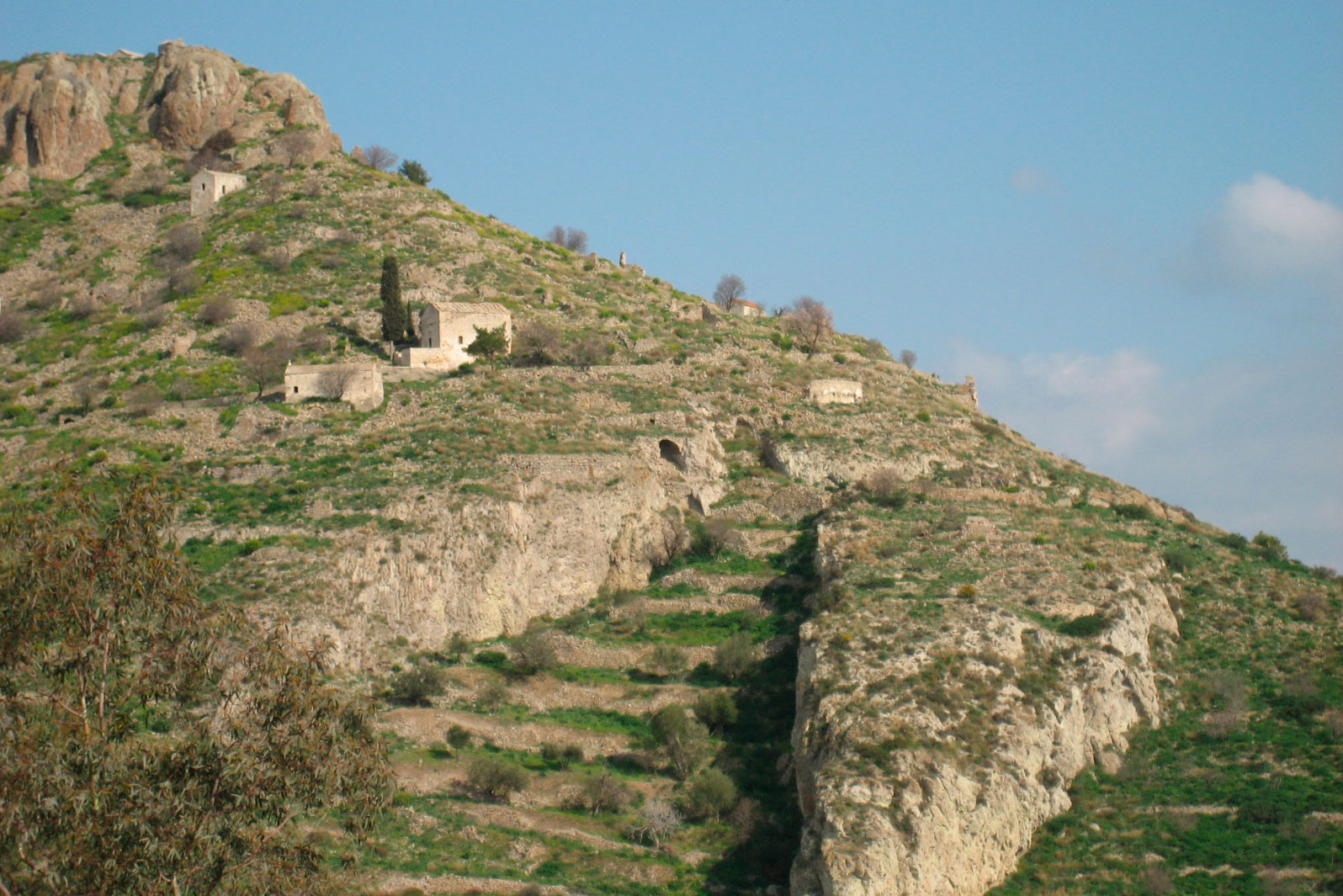
 On a steep hill adjacent to the church and monastery of Agios Nektarios is located Aegina's version of Mystras - Paleachora , whch means literally, "Old Town" , and which was for a millennium (9th century-early 19th century AD) the island's capital. The setting itself is magnificent , especially in spring, when all vegetation is a brilliant green both on the hill and in the valley below, seen in panoramic splendor from high above. All the remains of this hill village with its castle are its churches , rumored to number 365 - one for every day of the year - though this figure is unsupported by research. Of the 70 churches whose existence on the hill are confirmed , 33 of them remain and are open to visitors. Five have been restored and are in good condition, though most remain in great need of restoration.

Aegina
Aegina has a long history, dating from the Neolithic (4th millennium BC) to the later years. The high points in its history were the period if its great prosperity (657-459 BC) and the short period when it was proclaimed first capital and home of governor Ioannis Kapodistrias.
Witnesses to this historical path are the hill of Kolona with its characteristic column and the findings of ancient settlements, Paleachora with its post-byzantine churches, the Temple of Afea, the public buildings of the Kapodistrian period, Mount Hellanion/ Oros and the monastery of Chrysoleontissa. Some of the most important archaeological sights are below.

Hill of Kolona
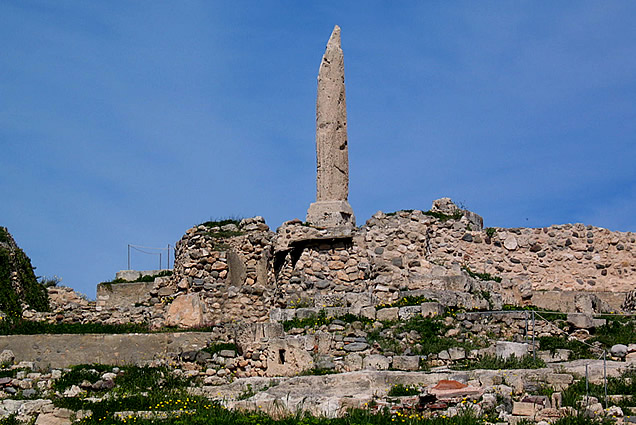
Just north of Aegina town is the hill with one single column (kolona in Greek), last remnant of a Doric Temple of Apollo, which was torn down with others - because they were deemed idolatrous - in the 4th century AD. Built in 520 BC of the porous Aegina sandstone, it stood on the site of previous temples on the prehistoric acropolis. It had 11 columns on the longer sides and 6 on the shorter ones. The upper portion of the one that remains is gone , fallen (along with the architrave) some time after 1765. A second column lasted till 1802, when it toppled during a storm. The frontispieces of the temple were made of Parian marble and depicted Amazonian battles.

The Temple of Afea
 On the site of the 5th century BC Doric temple of Afea in northeastern Aegina, an earlier temple existed from 570-510 BC which was destroyed by fire, though the cause is uncertain. One of the oldest of Greek Doric temples, its partial reconstruction is found in the inner portion of the Aphaia museum. This remarkable work was carried out by a man known locally by the Greek name Ludovikos, an "architectural archaeologist" who performed the most recent excavations on the site from 1967-84, in collaboration with German, English and Italian researchers. The workers were local Greeks, mostly from the nearby village of Mesagros, though also from Portes and Kylindros villages.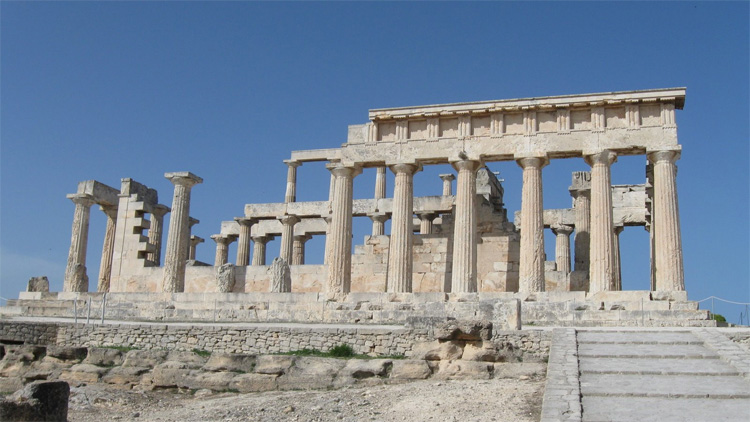
Paleachora ~ Aegina's Medieval Village
 On a steep hill adjacent to the church and monastery of Agios Nektarios is located Aegina's version of Mystras - Paleachora , whch means literally, "Old Town" , and which was for a millennium (9th century-early 19th century AD) the island's capital. The setting itself is magnificent , especially in spring, when all vegetation is a brilliant green both on the hill and in the valley below, seen in panoramic splendor from high above. All the remains of this hill village with its castle are its churches , rumored to number 365 - one for every day of the year - though this figure is unsupported by research. Of the 70 churches whose existence on the hill are confirmed , 33 of them remain and are open to visitors. Five have been restored and are in good condition, though most remain in great need of restoration.